

Do You Want to Become a Wonderseeker?
"There are Places that are not simply seen. They are felt."
THE PROJECT
What if we chose a Place for the emotion we want to feel?
We are used to picking a destination and then setting off. The Emotional Atlas of Wonder tries to reverse this perspective: starting from what we wish to feel and arriving at the Place that can evoke it.
The Seeker’s task is to listen, recognize the Wonder of a Place, and give it a name.
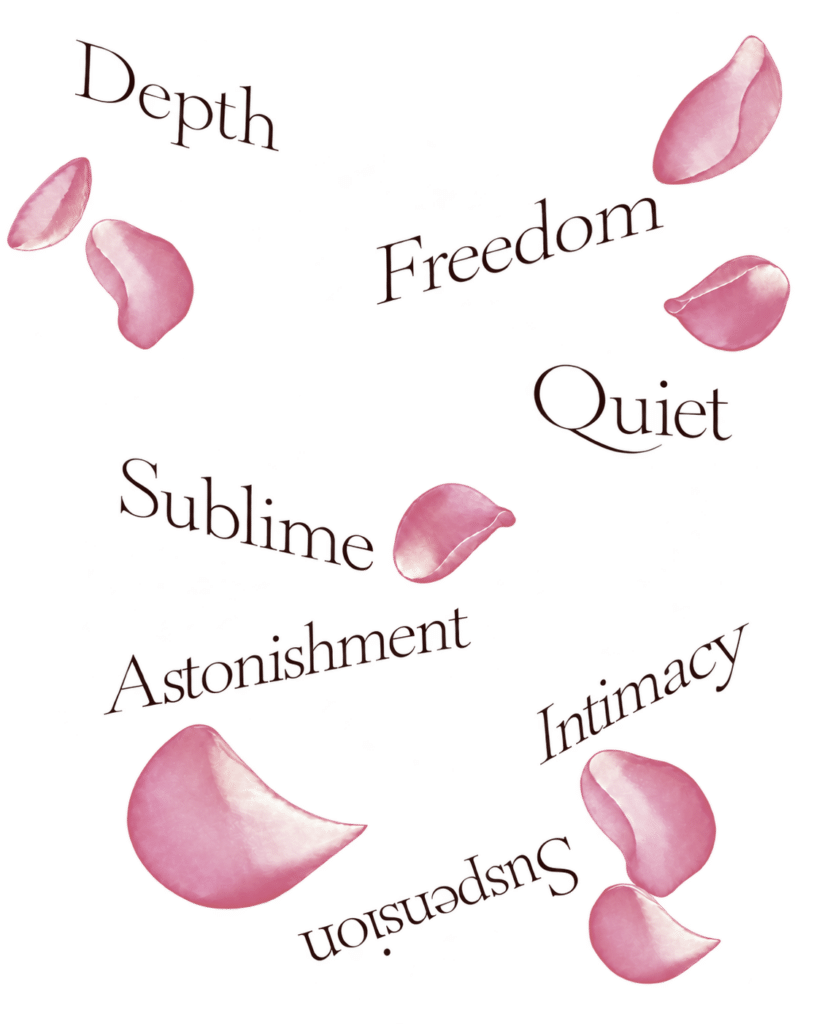

Some of the Seekers' emotions
Harmony
For me, HARMONY is not the absence of contrasts. It is the way different things can coexist without cancelling one another out. It is a living balance, never perfectly still, made up of continuous small adjustments. In this sense, I feel it is very close to the idea of Enchantment proposed by the project, in which a place is not merely something we observe, but becomes an inner experience, capable of bringing forth and naming a particular emotional nuance.
I think of HARMONY as breathing.
I inhale and welcome; I exhale and give back. I cannot do only one of these two things. Life itself seems to remind me constantly of this reciprocity. Day makes room for night, fullness for emptiness, movement for stillness. The body, too, takes what it needs and then lets go. What enters must, somehow, be able to leave. Holding on to everything would break the balance.
Perhaps this is precisely what HARMONY means to me: feeling that the body, thoughts, and emotions do not always say the same thing, yet they can listen to one another and find a shared message. I cannot imagine light without shadow, joy without the possibility of sadness, encounter without separation, life without death.
Everything seems to acquire meaning only through its opposite and through the continuous movement between balance and change.
And finally, there is emptiness, which may seem like a lack, but I try to think of it as available space. Where something is absent, there may be room for something else to arrive. A pause makes a new breath possible; silence allows us to listen; distance can create the desire to draw closer.
My nuance of HARMONY is therefore this: connection, balance, and exchange. Giving and receiving. Entering and leaving. Drawing near and letting go. Not trying to eliminate opposites, but allowing them to meet. And perhaps feeling in HARMONY means exactly this: sensing, for a moment, that nothing needs to be added and nothing needs to be taken away, because even what appears empty already has its own place.
Cristian Stifano – Dottorando in Scienze delle Relazioni Umane – Dipartimento For. Psi. Com Università degli Studi di Bari “Aldo Moro”
Enthusiasm
ENTHUSIASM is what makes us feel alive and truly living. The ability to feel enthusiastic is the most precious thing one can experience. The ENTHUSIASM we feel when watching the sun rise and usher in a new day, the ENTHUSIASM we feel when traveling to a new place or encountering a culture different from our own. It’s that drive that leads us to look at what’s in front of us with curiosity, as if, for a moment, we could free ourselves from routine.
We can be enthusiastic about something extraordinary, but also about what is small and seemingly ordinary: an unexpected conversation, a song heard at just the right moment, a familiar landscape bathed in a different light, a project that’s beginning to take shape. Perhaps this is precisely the value of ENTHUSIASM: it depends not only on what happens but on our willingness to let ourselves be moved by it. When we feel enthusiastic, time seems to take on a different quality: we are more present, more engaged, more open to what might happen. And it is perhaps in those moments—even the briefest ones—that we feel most clearly not only that we are alive but that we are truly living.
S.L. – Dottorando in Scienze delle Relazioni Umane – Dipartimento For. Psi. Com. Università degli Studi di Bari “Aldo Moro”
Depth
DEPTH is like when you listen to a song and every time you discover a detail you hadn’t noticed before; it can be hidden in a melody, a voice, a chord, or even a moment of silence. A song can make us happy or melancholy, nostalgic or calm. It can transport us straight to a specific moment in our lives. This doesn’t necessarily mean doing complicated things. Sometimes, just a few notes played just right can make us feel an overwhelming emotion. Music has the ability to go beyond what we hear with our ears and reach a much more intimate place.
Music helps us discover parts of ourselves that we often keep hidden. It’s a language that needs no explanation because certain emotions can only be understood by listening. DEPTH isn’t measured by counting the number of sounds, but by what the music leaves inside us.
Cristian
Astonishment
I’ve known the word “ASTONISHMENT” since I was a child, even though, in reality, I’d never actually felt that emotion back then. I experienced it recently, when I started studying at my high school, a scientific high school. One day, during science class, the teacher explained topics related to nature and astronomy, and showed us photos of the stars. In that moment, I felt ASTONISHMENT—at the Northern Lights, the astral aurora, and the other stars. What fascinates me is that even today, people continue to discover so many new stars, to study and observe the bodies in the sky. I remember once going to my grandmother’s house, in an area surrounded by mountains. In the morning, it seemed like a quiet town; there were very few cars. But one night, around 11:00 p.m., when I went out with my friends and we were walking along the brightly lit streets, I wondered why the streetlights were so bright. My friend told me to look up: I raised my head toward the sky and experienced true ASTONISHMENT—before, it had just been a picture I’d seen at school, but this time the stars were real!
The stars shine like sparkling pearls, and having studied them, I was able to recognize them. For example, “Polaris” is the most famous star, which points north. All of this represents ASTONISHMENT to me, because even though we keep discovering new things, we still don’t know the origin of the universe. We’ve made many discoveries, but there are still infinite spaces to explore. We don’t know how many yet, but this gives me a sense of just how small humanity is in the face of the infinite universe.
S. Y.-2^ D – Liceo Scientifico Statale “A. Scacchi” of Bari
Intimacy
In the shade of its broad, dense leaves, I often found a sense of protection and a profound care for my inner world—an attentiveness to the most distant passions and desires of the soul.
It is not merely a matter of introspection. For me, these are moments in which one feels the warmth of a cradle. In those moments, the mind and emotions move freely, untouched by any kind of judgment. Over the years, I have found that same warmth, that same INTIMACY, also in relationships with others: when a powerful feeling of love—whether familial, friendly, or romantic, it matters little—overcomes the barriers we naturally place between ourselves and the world, and only two individuals remain, in their purity. It has been an extraordinary experience for me, revealing that one can reach a profound state of INTIMACY by opening oneself to another person and to their understanding.
In a state of INTIMACY, time is suspended. The noise around us immediately becomes more muted; only an echo remains within us, whispering something to us, while everything else slips away, indifferent.
Emilio
Serenity
I remember every morning when I get out of bed and feel light and serene. The morning is a fresh start and a new experience. Even if yesterday was terrible, the next morning is all new. SERENITY is like tranquility. When you feel tranquil, you also feel serene.
SERENITY exists everywhere: for example, when you’re alone you can feel serene, or when you’re reading a book or spending time with friends. Other examples: a cup of tea at sunset, the rustling of the wind through the trees, a moment of silence without distractions or phones. SERENITY doesn’t mean not having problems, like pain or anxiety. It’s the ability to embrace your emotions without being overwhelmed by them; it’s knowing how to slow down instead of rushing around aimlessly. SERENITY is the most precious treasure a person can have. You can’t buy it, but you can find it within yourself.
L. J.-Liceo Scientifico Statale “A. Scacchi” of Bari
Waiting
WAITING is not merely an empty or passive period in which one expects something to happen or arrive. It can also be a time to pause and look within oneself—to explore, grow, improve, and understand what truly matters. At this moment, WAITING is teaching me patience above all, and showing me how it can be an alternative to simply rushing through life.
If I had to find a metaphor, I would say that WAITING is like being on a boat on a calm sea, still unable to see the destination.
And right now, I would like to imagine myself there: lying on that boat, contemplating the sky and the water. When everything moves quickly and without interruption, we risk living too automatically, without truly pausing to reflect on life itself. WAITING, instead, introduces a pause that can allow us to observe and give meaning to what we experience.
So, perhaps the lesson is to learn to be present while WAITING, and to appreciate this dimension of life as well.
Diana Sarcina
Dipartimento For. Psi. Com. Università degli Studi “Aldo Moro” di Bari
Amazement
It was a hot summer day when my mother decided to organize a trip to the theater because she was sure we would learn a lot. I didn’t understand what she meant—whether we’d learn some new behavior or experience as many emotions as possible. Still, I was so eager to learn so many new things!
When we arrived in front of the theater, I was overwhelmed by one particular sense of AMAZEMENT: first of all, the building was so large and majestic, like a palace. After going inside, I realized that the true beauty lay within, not on the outside. We took our seats and waited in silence for the show to begin: “Six Characters in Search of an Author.” The play is about six mysterious characters who suddenly interrupt the actors on stage, tell them they were created by an author who abandoned them, and ask to be let into the play so they can become real. After seeing this play, I couldn’t hide my AMAZEMENT because I loved the transition from the real world to the fictional one so much.
After returning home, the first thing I thought of was writing about this experience in my journal, because I don’t think I’ve ever seen anything that filled me with such AMAZEMENT. In the end, I can say that through this theater experience, I felt a new emotion and realized that the fictional world is so similar to the real world!
A. R. B.-1^E-Liceo Scientifico Statale “A. Scacchi” of Bari
The Chest of Emotions
When they are beautiful, we can experience them with greater intensity and learn to consciously find them again. This, too, is Emotional Competence.
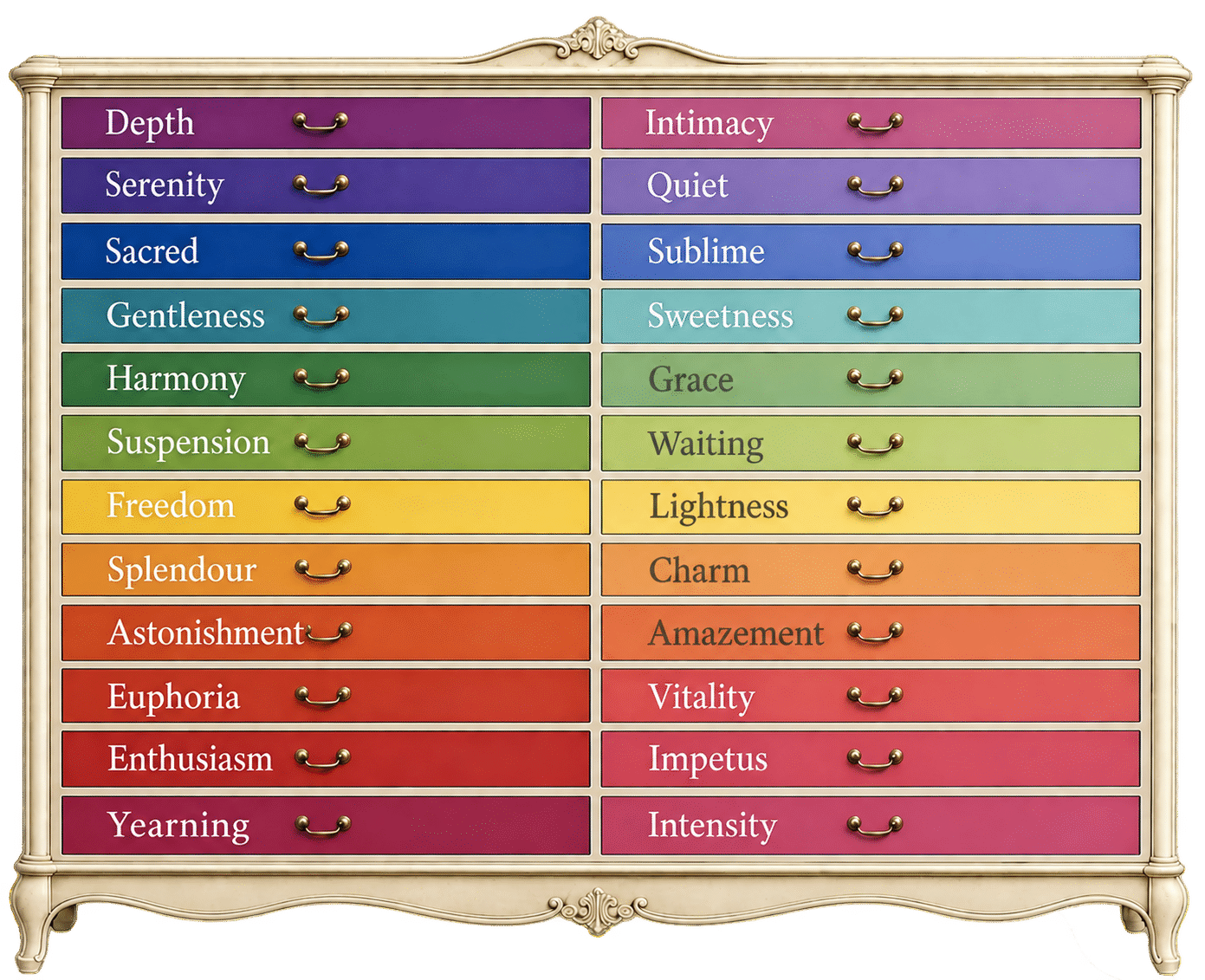
The Emotional Atlas of Wonder
37 places on this map:
- Grazia | Grace
- Quiete | Quiet
- Meraviglia | Astonishment
- Serenità | Serenity
- Stupore | Amazement
- Leggerezza | Lightness
- Leggerezza | Lightness
- Leggerezza | Lightness
- Leggerezza | Lightness
- Leggerezza | Lightness
- Soavità | Gentleness
- Armonia | Harmony
- Meraviglia | Astonishment
- Lievezza | Lightness
- Dolcezza | Sweetness
- Felicità | Happiness
- Sospensione | Suspension
- Quiete | Quiet
- Pace | Peace
- Attesa | Waiting
- Armonia | Harmony
- Serenità | Serenity
- Sublime | Sublime
- Leggerezza | Lightness
- Quiete | Quiet
- Meraviglia | Astonishement
- Attesa | Waiting
- Sospensione | Suspension
- Splendore | Splendour
- Fascino | Charm
- Stupore | Amazement
- Fermento | Excitement
- Libertà | Freedom
- Serenità | Serenity
- Libertà | Freedom
- Serenità | Serenity
- Intimità | Intimacy
Before the Atlas, there was a story
The year is 2024. In a world where the mysterious Power Agency spreads negative emotions among
humanity, the centuries-old Romantic School resists by training “Seekers”, figures able to reveal the
Wonder: the beautiful emotion held within every Place. Faced with an unusual wave of emotional
darkness, the veteran MAGISTER is forced to recall the SEEKER, the School’s most gifted operative,
who withdrew months earlier. The young man accepts the mission only in the hope of finding clues
about the TRANSMUTER, his vanished female mentor with whom he has fallen in love.
Joined by two teens, an insecure female MEASURER and a competitive male APPRENTICE, the
Seeker arrives in the city of Bari in search of a new Wonder. Suffering severe withdrawal symptoms
from having gone so long without absorbing a Wonder, his sensitivity now numb, the Seeker fails to
name the designated Place’s emotion. It will be his encounter with the KEEPER OF THE PLACE, a woman whose intense life experience allows him to reawaken his talent and, at last, give the Wonder its name.
Find a Place. Recognize its Wonder. Tell its story.
1.
Choose how to shoot your video
You're free to choose between two formats:

Option A – Voice-over:
Frame only the Place, without appearing on camera, while your voice tells the story.

Option B – Selfie video:
Frame yourself close up, with the Place clearly visible behind you, speaking to the camera.
2.
The formula to recite in your video
In your video, tell us these 4 key pieces of information:

Where you are
State the name of the Place, whether natural or urban.

The Name of the Wonder
Recognize the emotion the Place evokes and choose its name from the Chest of emotions


The Emotional Shade
Share a brief anecdote, a poem, a flight of fancy, or a piece of music the Place evokes

Your Name or Nickname
As a Wonderseeker
«I am here at ① San Nicola Pier in Bari. The name of the Wonder is ② Suspension. The Emotional Shade is: ③ I feel ad though I am floating between the sky and the sea, with no sense of hurry. I am ④ Michele, Wonderseeker.»
Example
Your Wonder deserves to be found
Become a Wonderseeker
Record your video, follow the four steps, and officially become a Wonderseeker.
CREDITS
PRODUCED BY

Zefirofiu
The project “Do You Want to Become a Wonderseeker?” was born from the vision of Zefirofiu, an independent production company from Puglia that conceives audiovisual content as an opportunity for individual and social growth, and that curated the project’s technical realization and workshops.
WITH THE SUPPORT OF

Ministry of Culture
Directorate General for Cinema and Audiovisual – Special Projects for Cinema and Audiovisual 2025.
IN COLLABORATION WITH

Scientific Lyceum of Bari “Arcangelo Scacchi”
INSTITUTIONAL PARTNER. This work was carried out as part of a project funded under the Special Projects program of the Ministry of Culture (MiC) – Directorate General for Cinema and Audiovisual, with the co-participation of the “A. Scacchi” State Science Lyceum.

SCIENTIFIC PARTNER. Department of Education Sciences, Psychology, Communication. It accompanies the project with its own contribution, strengthening the dimension of research and the enhancement of the relationship between places, emotions and territory.
WITH THE CONTRIBUTION OF

Fondazione Puglia
Supports the project and its development, contributing to the promotion of an initiative dedicated to the beauty of places and the emotional dimension of the experience.

Department for Knowledge – City of Bari
Contributed to the realization of the project, recognizing its educational value and its connection to the territory.
